Simon Knight
Telecommunications and software engineer in Adelaide, South Australia. I build tools at the boundary between network engineering and signal processing: deterministic protocol simulators, graph topology engines, large-scale spatial rendering, and bistatic signal reflection.
PhD in computer science (University of South Australia, 2017) on the automated configuration of large networks. The same compiler-and-graph approach shows up across most of the projects here.
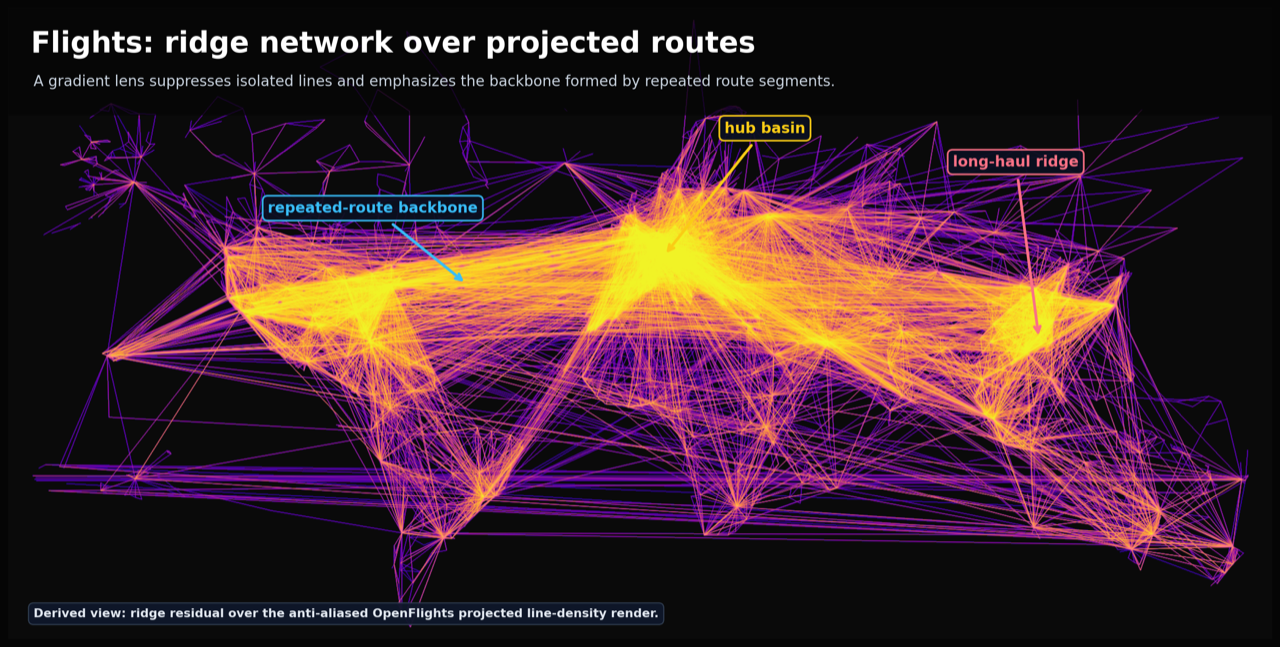 The global airline network — 67,000 great-circle routes — processed into a corridor ridge structure. Major hubs and the transoceanic corridors between them surface as bright spines instead of overlapping lines. One pass through DataRaster over the raw OpenFlights point cloud. DataRaster →
Featured Work
DataRaster
Rust-native engine for rendering massive spatial datasets into density maps and raster tiles. A ten-crate workspace with a CLI, tile server, and Python and WASM front ends — a deployment-friendly Datashader backend.
matrix-profile-rs
Matrix Profile algorithms (STOMP, SCAMP, SCRIMP++) in native Rust. Parameter-free motif and anomaly discovery in time series, with SIMD kernels and a Polars dataframe plugin.
Spectra
SDR-based spectrum monitoring that classifies and indexes everything it sees. Multi-radio capture feeds an ML pipeline that identifies modulations and writes a searchable signal census, with a TUI waterfall for live inspection.
Overtone
Generative psytrance synthesis from first principles. A multi-scale energy model drives procedural pattern generation; an effects chain and humanisation layer turn the result into a produced-sounding track. Tala-style additive rhythm biases the underlying grid.
Background
Bachelor of Engineering (Telecommunications, First Class Honours) and Bachelor of Economics from the University of Adelaide. PhD in Computer Science (2017) from the University of South Australia, where I developed the AutoNetKit modeling framework for automated network configuration.