Project Spectra

Phase 9/12

← Back to Signal Processing

Current Status

2026-02-17 — Completed 09-04-PLAN.md (E2E verification script + human checkpoint)


Concept

Monitor the local radio spectrum autonomously, classify every detected signal using ML, and maintain a persistent “Signal Census” — a queryable database of all RF activity over time. Distributed across Raspberry Pi edge nodes and a Mac mini core, the system runs unattended, sweeping bands, scheduling satellite passes, and logging what it finds.

Quick Facts

   
Status Phase 9/12
Language N/A
Started 2026

Current Status

2026-02-17 — Completed 09-04-PLAN.md (E2E verification script + human checkpoint)


Architecture

The system splits into edge and core nodes connected over Gigabit Ethernet:

┌─ EDGE (Raspberry Pi) ──────────────┐
  SDR Hub (Airspy, RTL-SDR, HF+)    
  SpyServer · rtl_tcp · readsb      
  IQ streaming over LAN             
└──────────────────┬──────────────────┘
                    Gigabit Ethernet
┌──────────────────▼──────────────────┐
  CORE (Mac mini)                    
  Python Orchestrator (2,000+ lines) 
  ML Classification Pipeline        
  Signal Census Database (DuckDB)   
  Web UI · Rust TUI · REST API      
  Autonomous Missions Engine        
└─────────────────────────────────────┘

The edge node handles USB device access and raw IQ streaming. The core node runs all processing — FFT, classification, detection, demodulation, and persistence. This split keeps the Pi’s job simple (stream bytes) while the Mac mini handles compute-intensive work.

v2.0 Central Server Architecture

Version 2.0 adds a central WebSocket server that multiplexes real-time spectrum data, classification results, and control commands to multiple clients simultaneously. The TUI and web interface now operate as thin clients — the server streams FFT frames, waterfall data, and signal detection overlays over WebSocket channels. This enables:

Phase 8 (WebSocket Foundation) complete. Phase 9 (Signal Intelligence Overlay) in progress — adding live classification stream and web-based detection visualization.

Terminal Interface

Spectra TUI Rust TUI showing live spectrum, waterfall (Kitty graphics protocol), and device controls.

The Rust TUI renders a pixel-level waterfall using the Kitty graphics protocol for true-color, full-resolution display directly in the terminal. Spectrum graphs use block-character rendering with configurable color palettes (twilight, inferno, viridis, ice, gray). Keyboard controls handle retuning, gain adjustment, and device switching without leaving the terminal.

Hardware

Four SDR types cover the spectrum from HF through L-band:

SDR Role Coverage
Kraken SDR Direction finding (5-channel coherent) 24–1766 MHz
Airspy R2 Wideband scanning (10 MSPS) 24–1700 MHz
Airspy HF+ Discovery HF/VHF reception 0.5–31 MHz, 60–260 MHz
RTL-SDR v3/v4 ADS-B (1090 MHz), satellite (137 MHz) 24–1766 MHz

Antenna array: Diamond D-130 discone (wideband), MLA-30 active loop (HF), TA1 turnstile (satellite), dedicated 1090 MHz (ADS-B), with mast-mounted Mini-Kits LNA for weak signals.

Signal Census

The core concept: every detected signal gets logged to a DuckDB database with timestamp, frequency, power, modulation classification, confidence score, SigIDWiki metadata matches, and bearing (from Kraken direction finding). This builds a persistent picture of the local RF environment over time.

Queries answer questions like:

Anomaly detection uses per-band/frequency/hour bucketing with p90+margin flagging — no tuning required.

ML Classification

Two-stage pipeline:

  1. Real-time model: Fast CNN inference on live IQ samples (2–5 ms latency). Classifies AM, FM, SSB, BPSK, QPSK, 16-QAM and others.
  2. Retrospective model: Deeper CNN triggered on low-confidence detections, using larger sample windows (8,192 samples) for improved accuracy.

Classification augmented by:

Autonomous Missions

The missions engine runs unattended scanning operations:

Each mission logs events to .logs/missions/{run_id}/events.jsonl for post-session review.

ADS-B Integration

Ingests Beast/SBS TCP feeds from readsb running on the Pi. Aircraft positions, altitudes, and callsigns appear on the tactical map alongside signal bearings and census hits. Historical observations are queryable via the API for replay.

Direction Finding

The Kraken SDR’s 5-channel coherent receiver enables phase-coherent direction-of-arrival estimation. Signal bearings render as lines on the tactical map, correlating with census entries and ADS-B aircraft positions.

Web Frontend

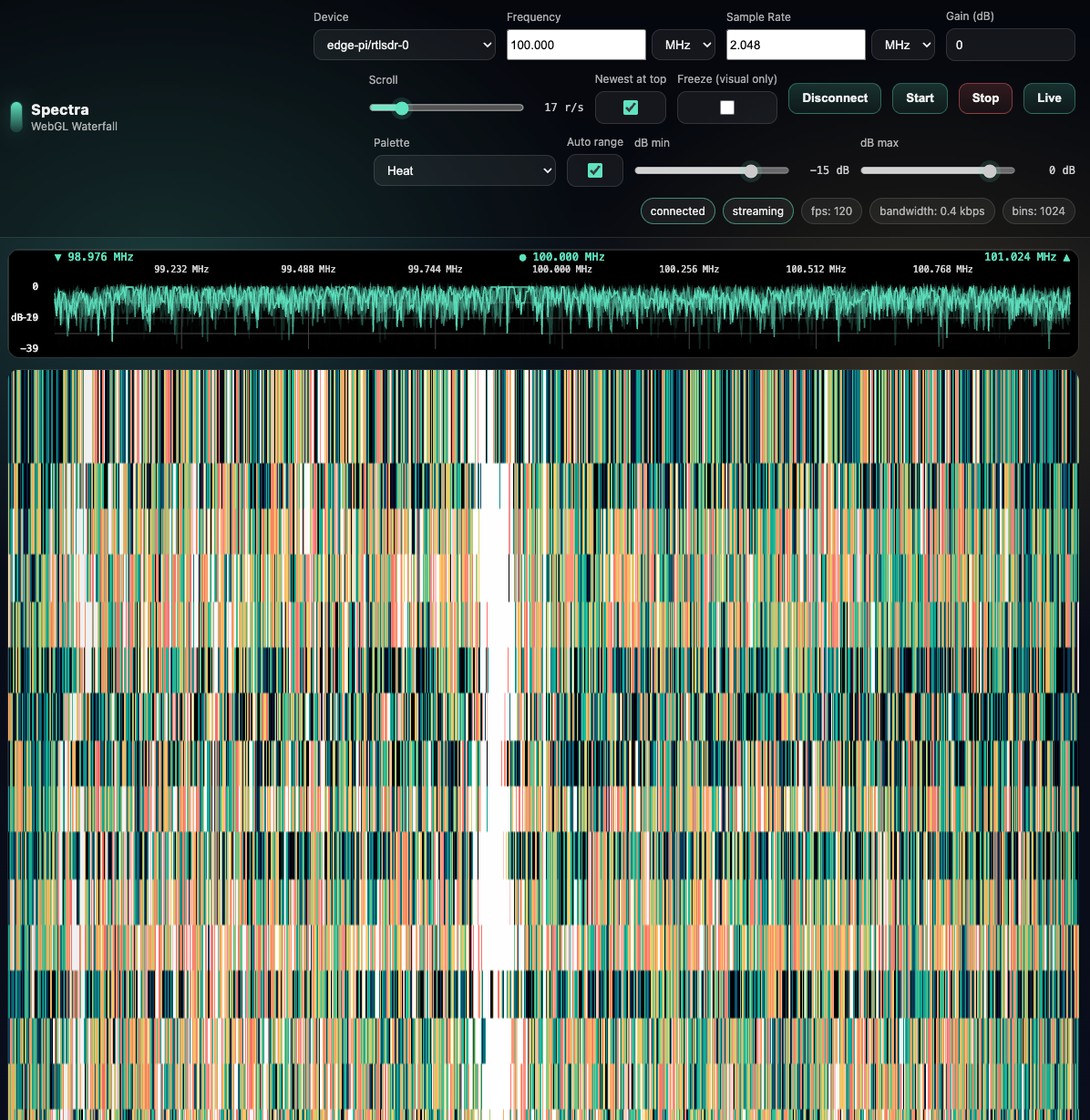
Spectra Waterfall WebGL waterfall display with real-time spectrum analysis.

React/TypeScript frontend with:

REST API

FastAPI backend with WebSocket support:

Endpoint Purpose
GET /devices SDR registry and status
PATCH /devices/{name}/settings Tune frequency, sample rate, gain
WS /ws/waterfall/{device} Binary spectrum frames (uint8)
GET /api/health/deep Structured health JSON
GET /api/map/live ADS-B + DoA bearings + census hits
POST /api/nlq Natural language queries (deterministic templates)

WebSocket protocol: one JSON metadata message followed by binary uint8 spectrum frames at 10–20 FPS.

Health and Resilience

Development Roadmap

Phase Focus Status
1 Foundation — streaming, waterfall, device control Complete
2 Intelligence — ML classification, constellation, demod Complete
3 Autonomy — Signal Census, scanning, satellites, missions Complete
6 Verification — health monitoring, auto-reconnect, E2E tests Complete
7 Performance — ring buffer, GPU FFT, batch updates Planned

Tech Stack

Core (Python): FastAPI, uvicorn, NumPy, SciPy, Polars, DuckDB, asyncio, Skyfield, httpx, Pydantic

Frontend (TypeScript): React 19, Vite, MapLibre GL, WebGL

TUI (Rust): ratatui, crossterm, rustfft, Kitty graphics protocol, axum (backend)

ML: CoreML, PyTorch, ONNX Runtime (RadioML 2018.01A training data)

Infrastructure: uv (package management), systemd (edge services), Docker (optional)

Current Status

2026-02-17 — Completed 09-04-PLAN.md (E2E verification script + human checkpoint)


← Back to Signal Processing