matrix-profile-rs
Contents
Concept
The matrix profile is a single transform that exposes a time series’ repeated patterns and its anomalies. It annotates every subsequence with the distance to its nearest match elsewhere in the series: low values mark motifs (a shape that recurs), high values mark discords (a shape unlike any other). It needs no training, no labelled data, and no domain-specific parameters.
matrix-profile-rs implements the STOMP, SCAMP, and SCRIMP++ algorithms in native Rust — 8,700 lines, 58 tests. SIMD kernels (AVX2 and NEON) give a 2.5x speedup over the scalar path, and memory-budgeted tiling keeps series larger than RAM within a fixed footprint.
Visuals
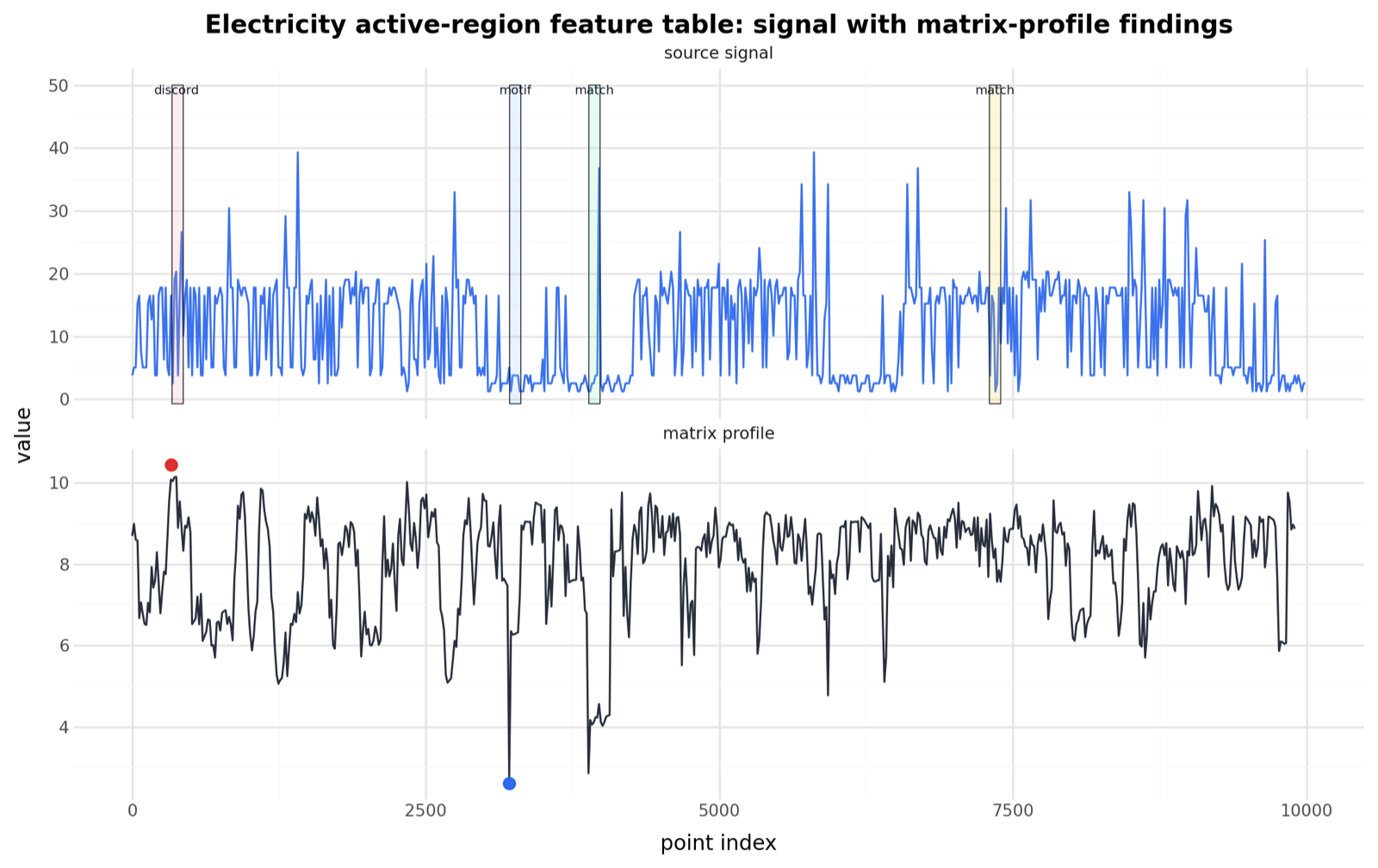 Top: an electricity-demand signal with the discovered discord and matching motifs boxed. Bottom: the matrix profile — its lowest point locates the strongest motif, its highest point the clearest anomaly.
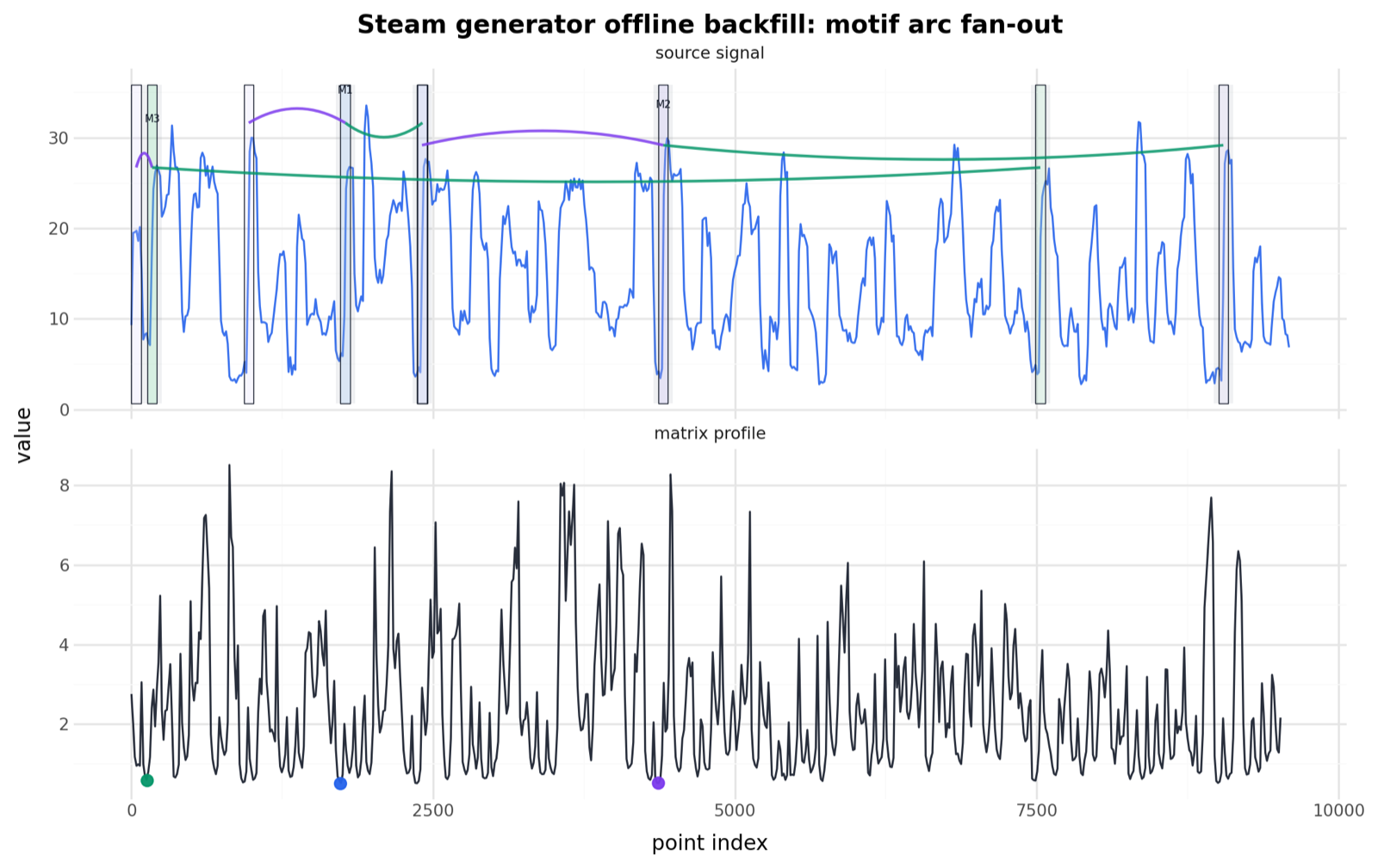 Motif arc fan-out: arcs connect each occurrence of a recurring shape across a steam-generator sensor trace, with the matrix profile below.
 Multi-stream join (v2.0.0): the profile annotates one electricity signal with the shape distance to its nearest match in a second signal, surfacing shared structure across two independently sampled feeds.
 Online streaming mode: a household sensor trace is consumed incrementally; motif and discord events are emitted as the profile updates, without re-running the full computation each tick.
Architecture
Three algorithms cover the exact-and-anytime spectrum:
- STOMP — iterative exact algorithm using a QT recurrence for sliding dot products.
- SCAMP — parallel exact algorithm with centered kernels for numerical stability.
- SCRIMP++ — anytime algorithm whose approximate result improves with budget.
Data flows from a Rust Array1<f64> or a Polars Series into a single
computation kernel — SIMD-accelerated when the data is contiguous, parallelised
across cores by Rayon, tiled when the series exceeds the memory budget. The
result is a MatrixProfile struct: distances, indices, and metadata, exposing
.top_k_motifs() and .top_k_discords() for discovery.
The Polars integration exposes the computation through a .mp() namespace on
Series, so motif and discord discovery composes with the rest of a Polars
pipeline:
import polars as pl

df = pl.read_parquet("sensor_data.parquet")
result = df.select(pl.col("vibration").mp().stomp(m=20))
Features
- Three Matrix Profile algorithms: STOMP, SCAMP, SCRIMP++
- Motif and discord discovery with deterministic tie-breaking
- Rayon parallel execution across all algorithms
- SIMD vectorisation (AVX2 and NEON) with transparent dispatch
- Memory-efficient tiling for datasets larger than RAM (N > 10⁶ validated under 64 MB)
- Polars plugin:
df.select(pl.col("ts").mp().stomp(m=20)) - Feature-gated Polars integration keeps the default build dependency-light
Current Status
Implementation status: Feature work complete through Current focus: documentation/release reconciliation, not missing streaming functionality Release posture: v1.0 shipped; v2.0-level streaming and multi-stream features are implemented in repo
Last updated: 2026-04-09 after completion and documentation reconciliation
Quick Facts
| Status | Last Active: 2026-04-30 |
| Stack | Rust, Polars |
Current Status
** 2026-04-30 — Published v2.0.0 release (commits and tags pushed to main)